
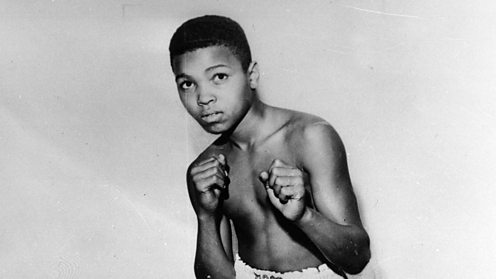
17 Jan 1942
A star is born
Muhammad Ali was born Cassius Clay Jr. in Louisville, Kentucky.
His father was a sign painter and his mother a part-time cook and cleaner for wealthy families. Although they lived in a middle-class black neighbourhood, Kentucky law enforced a code of racial segregation that precluded black people from using many of the same public facilities as their white neighbours. The indignities forced on Clay and his family, as well as national outrages such as the racially-motivated murder of 14 year old Emmett Till in 1955, deeply troubled Clay from an early age.
17 January 1954
A stolen gift
When Clay was twelve years old, his parents bought him a bike for his birthday. It was stolen while he was at a local fair.
Furious, Clay went to report the theft to a local policeman named Joe Martin. Martin was a boxing instructor as well as an officer. As Clay threatened to find and beat up the thief, Martin suggested he learn how to fight before dishing out threats. Martin became Clay’s first trainer. Clay soon won an array of titles on the amateur boxing circuit under Martin's guidance

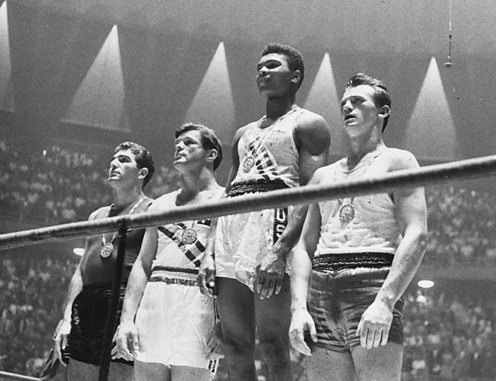
5 September 1960
Clay wins gold
At 18, Clay qualified for the Olympics in Rome. He charmed the world media and proved popular among his fellow athletes.
He proved himself in the ring too, winning gold as a light-heavyweight. Clay was famously proud of his medal, wearing it constantly during his stay in Italy and on his return to the United States. He was honoured with a victory parade in his home town of Louisville but was later refused service in a whites-only diner and other public facilities. The segregation laws still applied to him - Olympic champion or not.
29 October 1960
Turning professional
Eight weeks after his victory in Rome, Clay won his first professional bout. All the trademarks of his unorthodox style were on display.
Clay had immense confidence in his speed and agility, often leaving his guard down and leaning back to avoid punches. Clay's showmanship was also evident in early bouts, as he dazzled media and fans with his bravado and predicted the round in which his fights would end. He faced tough opponents, including popular Englishman Henry Cooper, who knocked him down with a powerful left hook. But Clay maintained an unblemished ring record. He would soon prove himself against his toughest opponent yet.

6 March 1964
Muhammad Ali is born
Speculation about Clay's religious beliefs had been fuelled by his relationship with black civil rights leader and Nation of Islam member, Malcolm X.
After defeating Liston, Clay publicly acknowledged he was a member of the religious movement. In March, he was given the name Muhammad Ali by his spiritual mentor, Elijah Muhammad. Ali accepted the group's controversial doctrine, including a call for apartheid between the races. It made him a pariah in some circles but, for many, he was a symbol of black pride, refusing to play the role of the 'compliant negro' in order to gain acceptance from the white establishment.
28 Apr 1967
Ali vs. US government
As war unfolded in Vietnam, Ali received a notice drafting him into the US Army. His next fight would be in a courtroom, rather than a boxing ring.
Ali objected to serving in the military because of his religious beliefs. He also referenced the mistreatment of black Americans, saying he refused to co-operate with the US government in oppressing another race of people. He was stripped of his championship, indicted for draft evasion, fined $10,000 and sentenced to five years in prison. Three years later, his conviction was overturned. Away from the ring, Ali toured colleges and spoke out on a variety of social and political issues.
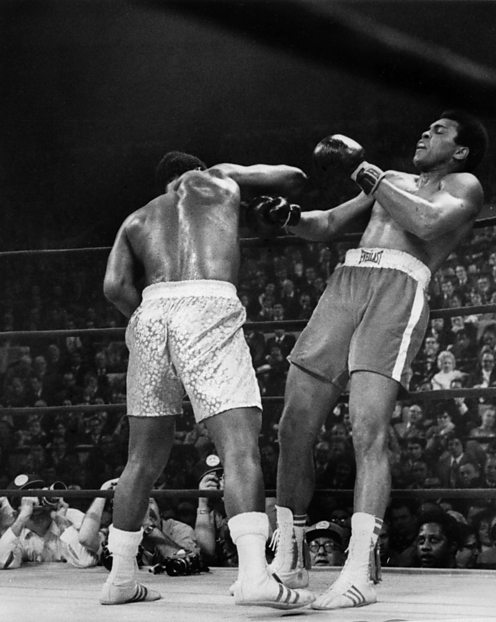
8 March 1971
'The Fight of the Century'
In 1970, Ali returned to boxing, knocking out Jerry Quarry and Oscar Bonavena. Next up was Joe Frazier, who had become the heavyweight champion.
Frazier and Ali clashed over more than just the title: to Frazier’s dismay, the two men became symbols and proxy warriors for opposing social, political, and religious beliefs. Ali, an outspoken advocate of black self-realisation, dismissed Fraizer in pre-fight interviews as an 'Uncle Tom.' Their fight at Madison Square Garden was watched by millions of people in America and around the world. Frazier won a unanimous 15-round decision - it was Ali’s first professional loss.
30 Oct 1974
Rumble in the Jungle
Ali had a chance to reclaim his title in Zaire against a new world champion: the hard-hitting heavyweight George Foreman.
Again, Ali entered the ring as a 3-to-1 underdog. But in front of 80,000 fans, he unveiled a new tactic - the ‘rope-a-dope’. Leaning back against the ropes, Ali avoided most punches to the head and absorbed punishing body blows before counter-attacking with straight right hands. In the middle rounds, Foreman tired. In round eight, Ali launched a powerful combination that knocked the champion to the canvas. "Oh my God," said BBC commentator Harry Carpenter, "he's won the world title back at 32.”
10 Dec 1974
A global superstar
Ali’s victory over Foreman reinforced his position as the most recognisable person on the planet.
His famous fans included Elvis, Bertrand Russell and Nelson Mandela. In an effort to heal rifts caused by the war in Vietnam and racial divisions within the United States, President Gerald Ford invited him to the White House in December 1974. Then, in 1975, Ali abandoned Nation of Islam teachings in favour of orthodox Islam. He has since declared, “Colour doesn’t make a man a devil. It’s the heart and soul and mind that count.
1 Oct 1975
Thrilla in Manilla
It had been four years since Ali won a low-key rematch against Joe Frazier in New York. Their rivalry stood at one win each.
Ali's womanizing became a sub-plot to the bout after he brought his mistress to a reception at the presidential palace in Manila. Meanwhile, tensions between Ali and Frazier were running higher than ever, as Ali continued to goad his opponent in public. He branded Frazier ‘a gorilla.’ The fight lasted a punishing 14 rounds. Ali prevailed when Frazier’s corner halted the brutal back-and-forth carnage. Ali later described the fight as “the closest thing to death” he’d ever experienced.
Sept 15 1978
The later years
After Manila, Ali defended his championship six times before his loss to Leon Spinks, a largely untested fighter with seven pro fights to his credit.
Seven months later, in September 1978, he defeated Spinks in a rematch to claim the heavyweight crown for an unprecedented third time. After a brief retirement, Ali made an ill-advised comeback against Larry Holmes and suffered the only knock-out loss of his career. He retired permanently at age 40 with a ring record of 56 wins and 5 losses.
5 Feb 1980
On the world stage
Ali was not a diplomat but he was enlisted into diplomatic causes by the US government due to his popularity at home and abroad.
In 1980, President Carter sent Ali to Africa to gather support for a US-led boycott of the Moscow Olympics. But the mission offended many African leaders and was widely considered to be a diplomatic failure. In 1990, Ali went to Iraq on his own accord to help negotiate the release of American hostages captured after Saddam Hussein's invasion of Kuwait. Fifteen hostages were released, aided by Ali's profile.
1984
A new fight
In the early 1980s, Ali developed noticeable tremors and slurs in his speech. In 1984, he was diagnosed with Parkinson's.
Ali's physicians linked his condition to the repeated blows to the head sustained during his boxing career. Ali, however, has stated that he does not believe his condition is caused by boxing. In the ensuing years, Ali became a visible symbol of courage in the face of physical disability and helped raise millions of dollars for the Muhammad Ali Parkinson's Center.
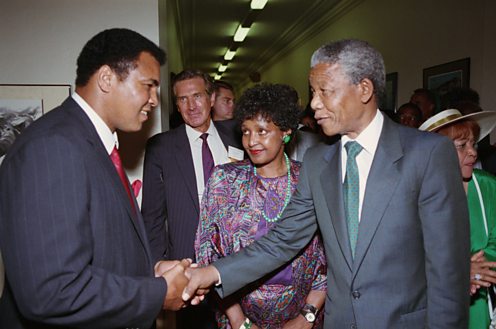
29 June 1990
Fighter turned philanthropist
Throughout his retirement, Ali has devoted himself to humanitarian work and charitable causes.
Many of Ali's most high profile fights were staged in developing countries, partly in a bid to shine a global spotlight on them. He continued to make trips as a goodwill ambassador to troubled nations, such as North Korea and Afghanistan, and delivered $1 million of medical supplies to Cuba. In 1990, Ali met Nelson Mandela in Los Angeles, paying his respects to a fellow advocate of civil rights and political freedom.
19 July 1996
An emotional return
In the summer of 1996, a trembling Muhammad Ali lit the Olympic flame in Atlanta.
His appearance generated a worldwide outpouring of love, reaffirming his status as an iconic symbol of tolerance, understanding, and courage. In 1999, in acknowledgement of his humanitarian work in impoverished countries, Ali was named a United Nations Goodwill Ambassador. A Hollywood movie starring Will Smith dramatising his life and career was released in 2001. Ali made a number of public appearances to promote the film.
14 Nov 2005
The champion honoured
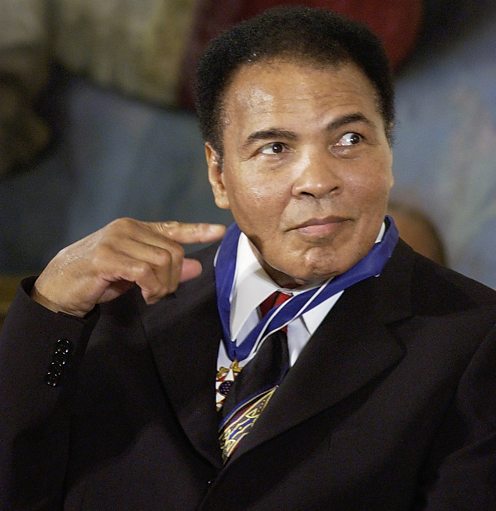
Ali has been the recipient of a myriad of honours, in appreciation of his lifelong fight for civil rights and religious freedoms.
In 2005, Ali was awarded the Presidential Medal of Freedom, the highest honour that can be bestowed on a civilian in America. Although he did not speak, Ali's sense of humour was still on full display: when President Bush threw a mock punch at the former champion, Ali twirled a finger round his head to indicate he would be crazy to take him on in a fight. That same year saw the opening of the Muhammad Ali Center in Louisville, a non-profit museum celebrating Ali's life and achievements.
27 July 2012
A living legend
Over fifty years after his first attendance at the Olympic Games in Rome, Ali made a poignant return to the world stage.
At the 2012 Olympics in London, Ali was designated as an honorary flag bearer. Although his frail physical condition prevented him from carrying the flag, he stood for part of the ceremony with the support of his wife, Lonnie. Ali's appearance was rapturously received by fans in the packed stadium and around the world; a fitting tribute to one of the greats of sporting history whose remarkable life transcends the ropes of the boxing ring.


No comments:
Post a Comment